LESSON 5B · A DEEPER DIVE AFTER LESSON 5
One Ion, Dot by Dot: The Sulfate Lewis Picture
In Lesson 5 you learned that atoms stick together by sharing electrons. In Lesson 8A you met the sulfate ion, SO42−, as a team of atoms carrying one charge. This page slows right down on one drawing of that team — an electron-dot picture, also called a Lewis picture — and reads every single dot in it.
1The picture
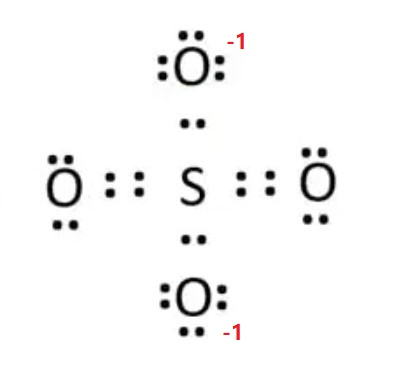
One sulfur atom sits in the middle, with four oxygen atoms around it. Every dot is one electron. Some dots sit between two atoms, some hug a single atom, and two of the oxygens carry a small red −1. By the end of this page you will be able to explain every one of those marks.
A drawing like this is a counting map, not a photograph: it keeps track of the electrons and shows how they are shared. The real ion is a 3D object (spin it in Lesson 8A) — this flat picture is for counting.
2How to read it: three kinds of marks
Shared pairs
A pair of dots between two atoms is a pair of electrons the two atoms share — that is one bond. Two pairs side by side between the same two atoms are two shared pairs — a double bond.
Lone pairs
Pairs of dots drawn around the outside of one atom belong to that atom alone. They are not shared with anybody — chemists call them lone pairs.
The red −1 marks
A −1 next to an atom means: in this drawing, that atom owns one extra electron — one more than it started with. Section 5 shows how to check that for yourself.
3Two kinds of oxygen
All four oxygens are the same element — but in this drawing they do two different jobs.
Top and bottom oxygens
Each is joined to sulfur by one shared pair (a single bond), and each carries three lone pairs of its own. These are the two oxygens marked −1.
Left and right oxygens
Each is joined to sulfur by two shared pairs (a double bond), and each carries two lone pairs. These two wear no mark — in this drawing they own exactly their own electrons.
And the sulfur in the middle? It shares pairs with all four oxygens and has no lone pair left over.
4Count every dot
Let us count the whole picture and check it against what the atoms bring.
| What we count | Pairs | Electrons |
|---|---|---|
| Shared pairs: 2 single bonds (1 pair each) + 2 double bonds (2 pairs each) | 6 pairs | 12 |
| Lone pairs: 3 + 3 on the top and bottom oxygens, 2 + 2 on the left and right oxygens | 10 pairs | 20 |
| Total electrons drawn | 16 pairs | 32 |
Now the check. Sulfur brings 6 outer electrons, and each oxygen brings 6 too: 6 + 4 × 6 = 30. The ion's charge is 2−, which means the team has gained 2 extra electrons: 30 + 2 = 32. The picture and the shopping list agree — that is how you know the drawing is complete.
One surprise: count the electrons around the sulfur and you get 12, not 8. The famous “eight” rule (the octet rule) is a guideline, not a law. Sulfur sits in the third row of the periodic table, and atoms from that row can hold more than eight electrons around them in drawings like this one.
5Why exactly two oxygens wear −1
Here is the owning rule chemists use, called formal charge: an atom owns all of its lone-pair electrons, plus half of every shared pair it takes part in. Compare what it owns with what it started with (6 for both sulfur and oxygen).
| Atom | Owns | Result |
|---|---|---|
| Top oxygen (and bottom oxygen) | 6 lone + half of 2 shared = 6 + 1 = 7 | 7 − 6 = 1 extra → −1 |
| Left oxygen (and right oxygen) | 4 lone + half of 4 shared = 4 + 2 = 6 | 6 − 6 = 0 → no mark |
| Sulfur | 0 lone + half of 12 shared = 6 | 6 − 6 = 0 → no mark |
| Add up the whole ion | −1 −1 + 0 + 0 + 0 = −2 ✓ |
The marks add up to exactly the ion's charge, 2−. Nothing is missing and nothing is double-counted.
Lesson 8A counts a different drawing of the same ion — four single bonds, where the same owning rule gives sulfur +2 and each oxygen −1. The next section explains why chemists usually prefer the drawing on this page.
6Why the double bonds? Fewest charges wins
Try drawing sulfate with four single bonds first. The counting still works — 32 electrons, every oxygen with three lone pairs — but now look at the owning scores: every atom wears a charge. Sulfur owns only half of its 8 shared electrons — 4 — so its score is 6 − 4 = +2; each oxygen owns 7 against the 6 it started with, so all four are −1. Five charged atoms is a lot of separation — like five people in one room all owing each other money.
So chemists tidy the drawing up: let two of the oxygens share a second pair with sulfur. Nothing is added or removed — a lone pair simply becomes a shared pair. Watch what happens to the scores: those two oxygens drop to 0, sulfur drops to 0, and only the other two oxygens keep their −1. Same 32 electrons, same total charge of −2 — but only two charged atoms instead of five.
The rule of thumb: the best Lewis drawing is the one with the fewest and smallest formal charges. That is exactly the drawing at the top of this page.
One last subtlety: the double bonds are not glued to the left and right. You could draw an equally good picture with them on the top and bottom instead — chemists call such twin drawings resonance structures. In the real ion, all four sulfur–oxygen bonds are identical: the sharing is averaged over all four oxygens, and the extra charge is spread over all of them, not parked on just two.
7Check yourself
1. How many lone pairs does the bottom oxygen have?
2. Which is a double bond: sulfur–top oxygen, or sulfur–left oxygen?
3. The picture holds 32 electrons, but the atoms themselves only bring 30. Where did the last 2 come from?
4. Why does the picture at the top use two double bonds, instead of four single bonds like the first drawing in Lesson 8A?
8The whole story in four lines
A dot pair between two atoms is a shared pair — a bond. Two pairs side by side make a double bond.
Dot pairs hugging one atom are lone pairs: electrons that atom keeps to itself.
In this drawing, two oxygens are single-bonded and wear −1 each; two are double-bonded and neutral — and the marks add up to the ion's 2− charge.
Chemists prefer this drawing because it has the fewest formal charges — and counting every dot gives 32 electrons: 6 + 24 from the atoms, plus the 2 extra electrons of the charge.